The Cost of War in Lebanon Isn’t Just the Damage. It’s the Growth That Never Happened
From 2023 to 2026, conflict has damaged businesses, tourism, investment and household purchasing power. But Lebanon’s biggest economic loss may be the opportunities that never had the chance to exist.
 Mike Sader8 min read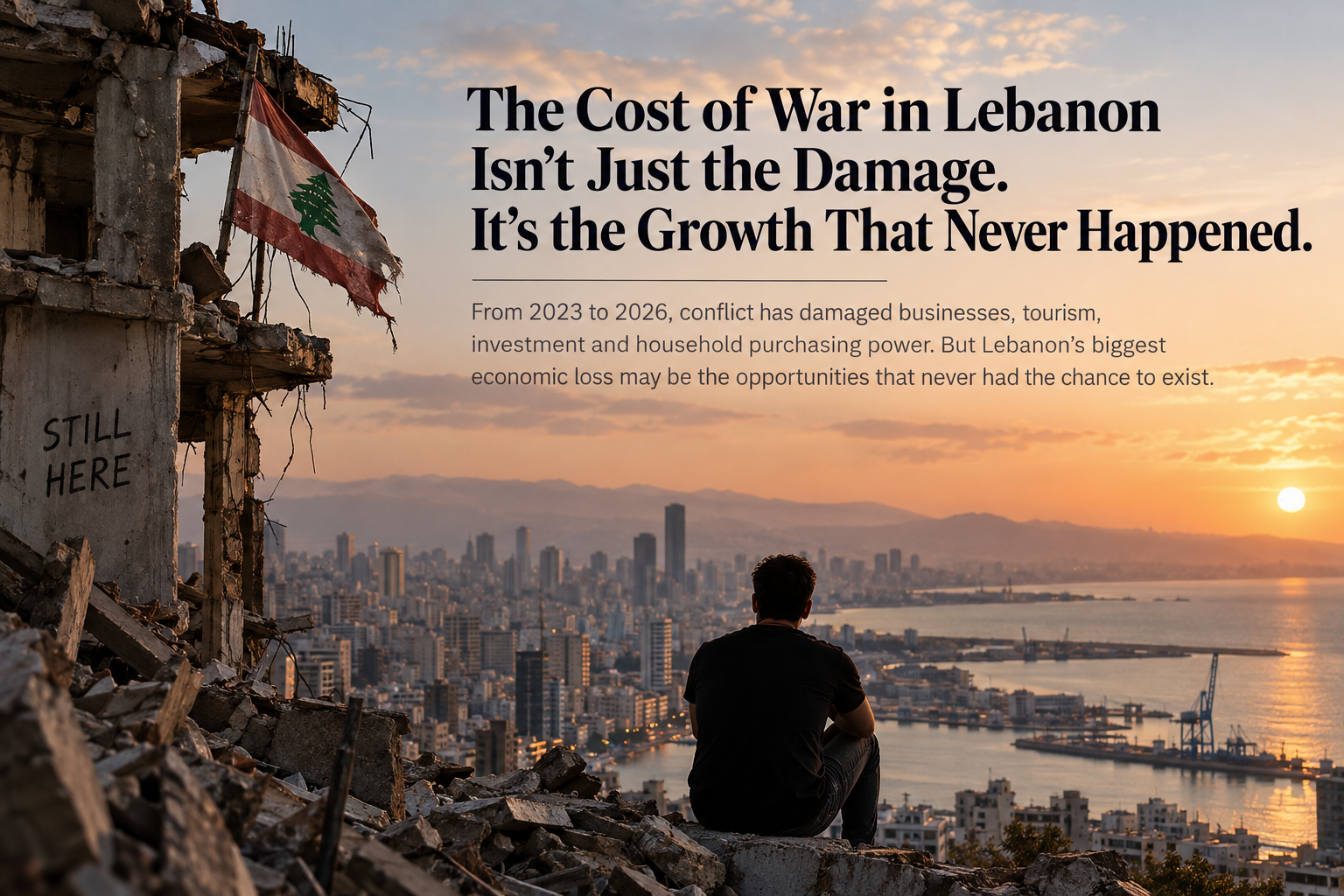
When we think about the economic cost of war, we usually think first about destroyed buildings, damaged infrastructure and businesses forced to close. Those losses are visible and relatively easy to measure, but they represent only part of what Lebanon has experienced since the conflict began in October 2023.
The less visible cost is the economic activity that never happened: the hotel expansion that was postponed, the restaurant branch that was never opened, the tourist who cancelled a summer trip, the investor who chose another country and the Lebanese professional who decided that building a career abroad offered greater stability.
For Lebanon, these missing opportunities may ultimately prove just as important as the physical destruction itself.
An Already Fragile Economy Was Hit Again
Lebanon entered the conflict after several years of financial crisis, banking instability, sovereign default and declining purchasing power. Despite those conditions, parts of the private economy had started adapting, with businesses increasingly operating in dollars, tourism recovering, diaspora spending supporting consumption and entrepreneurs continuing to operate despite extremely limited access to conventional bank financing.
Before the conflict, Lebanon had been expected to return to modest economic growth in 2023 for the first time since 2018. Instead, the World Bank estimates that real GDP contracted by approximately 0.8% in 2023, compared with estimated growth of 0.2% in a scenario without the conflict.
The deterioration became significantly more severe in 2024, when the fighting escalated and the effects spread through tourism, consumption, investment, employment and business activity. The World Bank's final assessment estimated that real GDP contracted by 7.1% in 2024, compared with potential growth of around 0.9% without the conflict.
By the end of 2024, Lebanon's economy had become nearly 40% smaller in real terms than it was in 2019, showing how the war compounded an economic crisis that was already exceptionally severe.
Lebanon's Economic Trajectory Since 2023
| Year | Real GDP Growth | What Happened |
|---|---|---|
| 2023 | -0.8% | Conflict beginning in October reversed an estimated pre-conflict growth rate of +0.2%, with tourism and confidence immediately affected. |
| 2024 | -7.1% | The conflict escalated significantly. Without the war, growth was estimated at around +0.9%. |
| 2025 | +4.2% estimated | Tourism, consumption and investment recovered as security conditions improved, producing the strongest growth since the 2019 crisis. |
| 2026 | -6.4% projected | Renewed conflict from March interrupted the recovery. The World Bank estimates growth will be 10.4 percentage points below a non-conflict scenario. |
The table captures one of the most important features of Lebanon's recent economic experience: the problem has not simply been destruction, but the repeated interruption of recovery. Every time activity begins to strengthen and confidence starts returning, another shock forces businesses, consumers and investors to become defensive again.
The Economic Cost Went Far Beyond Physical Damage
For the conflict period between October 2023 and December 2024, the World Bank estimated an overall economic cost of approximately $14 billion.
Of that amount, around $6.8 billion represented physical damage, while another $7.2 billion represented economic losses from reduced productivity, lost revenues and additional operating costs. The World Bank also estimated that Lebanon would require approximately $11 billion for recovery and reconstruction, of which between $6 billion and $8 billion may need to come from the private sector.
This distinction is essential because a company does not need to have its building destroyed in order to suffer financially. A hotel with empty rooms, a retailer with fewer customers or a manufacturer operating at half capacity can experience significant economic losses while its physical assets remain completely intact.
Lebanese Businesses Paid a Heavy Price
The effect on businesses was particularly severe because Lebanon's economy depends heavily on micro, small and medium-sized enterprises.
A major UN assessment published after the 2024 war found that approximately 77% of surveyed businesses experienced a significant decline in sales. Among micro, small and medium-sized businesses, 15% permanently closed, while 75% suspended operations at some point during the war. Nearly 30% reported losing their entire workforce.
The effect was even more dramatic in the areas most directly affected by the fighting, where as many as 70% of businesses were forced to close completely during the war.
For a small Lebanese company, several months of weak revenue can quickly become a survival problem. Rent, electricity, salaries and supplier payments continue even when customers disappear, which means that owners begin using cash reserves, cutting expenses, delaying investments and eventually reducing employment.
The impact then spreads beyond the original business. Employees who lose income spend less, suppliers receive fewer orders and other companies experience weaker demand, creating a multiplier effect across the economy.
Tourism Shows How War Affects Businesses Far From the Battlefield
Tourism provides one of the clearest examples of how uncertainty can damage an economy without physically destroying assets.
A tourist arriving in Lebanon does not spend money only on a hotel room. Visitors support restaurants, transportation companies, nightlife, retail stores, beaches, mountain destinations, events and many other businesses, while Lebanese expatriates returning during the summer and holiday seasons provide an important source of foreign currency.
When the conflict began in October 2023, UNDP reported that restaurant activity across Lebanon fell by as much as 80% during weekdays and between 30% and 50% during weekends compared with the beginning of that month.
As the conflict intensified in 2024, tourism was hit even harder through cancelled flights, international travel warnings and weaker visitor confidence. The losses eventually formed part of the approximately $3.4 billion in economic losses recorded across commerce, industry and tourism during the 2023–2024 conflict.
The important point is that a hotel does not need to be destroyed for the hotel owner to lose money. If tourists believe a destination is unsafe, demand can disappear long before physical infrastructure is damaged.
2025 Showed What Stability Could Deliver
The recovery during 2025 provides an important contrast. According to the latest World Bank estimates, Lebanon's economy expanded by approximately 4.2%, its strongest annual growth since the beginning of the financial crisis in 2019.
The rebound was supported by stronger tourism, private consumption and investment, demonstrating that Lebanon still possesses substantial economic potential when uncertainty declines. Its diaspora remains economically important, the country continues to have a strong tourism offering, and its private sector has repeatedly demonstrated an ability to adapt under extraordinarily difficult conditions.
The problem is that economic growth requires more than the ability to recover after a crisis; it requires enough stability for businesses to invest continuously over several years.
That continuity was interrupted again in 2026.
Another Recovery Interrupted in 2026
Following renewed conflict beginning in March 2026, the World Bank revised Lebanon's outlook sharply downward and now projects that real GDP will contract by 6.4% in 2026.
Even more importantly, the World Bank estimates that growth will be approximately 10.4 percentage points lower than it would have been under a non-conflict scenario.
This is perhaps the clearest illustration of the real opportunity cost of war. Lebanon is not simply losing existing assets; it is losing economic growth that could otherwise have taken place.
Businesses that might have expanded become cautious, households reduce discretionary spending, tourism slows and investors postpone decisions until they have greater visibility over the future.
The Missing Opportunities May Be the Biggest Loss
Traditional assessments of war focus heavily on what has been destroyed, but there is another category of loss that is much harder to calculate: what was never created in the first place.
Consider an investor evaluating whether to put several million dollars into Lebanon. That investor is not comparing one Lebanese project only with another Lebanese project; the same capital could potentially be invested in the UAE, Saudi Arabia, Cyprus, Jordan or another market where the operating environment is more predictable.
Repeated conflict increases Lebanon's risk premium. Investors must consider whether flights could be disrupted, whether employees might leave, whether supply chains could be interrupted and whether customers will continue spending during another crisis.
As the perceived risk increases, some investments simply stop making financial sense.
The factory is never constructed. The hotel is never developed. The restaurant does not open another branch. The multinational company places its regional office somewhere else.
Because these investments never existed, they never appear in estimates of physical damage, but Lebanon still loses the jobs, salaries, tax revenues, productivity and future investment they could have generated.
Businesses Shift From Growth to Survival
Repeated instability also changes the decisions of companies that are already operating in Lebanon.
In a stable economy, a profitable business may reinvest its earnings into machinery, technology, employees, marketing or new locations. In an unstable environment, the same owner may rationally decide to keep more money in cash, reduce inventory, delay hiring or invest part of the company's capital abroad.
From the perspective of the individual business owner, protecting liquidity is often the responsible decision. From the perspective of the entire economy, however, thousands of businesses making the same choice means less investment, weaker productivity and slower employment growth.
Lebanon therefore risks creating an economy in which businesses become exceptionally good at surviving crises but increasingly reluctant to scale.
The Real Cost Is Larger Than the Reconstruction Bill
The $14 billion estimated economic cost of the 2023–2024 conflict already demonstrates the scale of the damage, but it cannot capture every investment that was cancelled, every tourist who chose another destination, every company that postponed expansion or every skilled Lebanese professional who decided to build a future abroad.
Nor does that figure include the full economic consequences of the renewed conflict in 2026.
Rebuilding homes, businesses and infrastructure remains essential, but reconstruction mainly replaces assets that Lebanon already possessed. Sustainable growth requires something more: an environment where businesses and investors believe that the capital they commit today can continue generating returns five or ten years from now.
Lebanon's biggest economic loss may not ultimately be what the war destroyed, but what repeated instability prevented the country from ever building.
The rebound of 2025 showed that Lebanon can still recover quickly when conditions improve, but resilience cannot permanently substitute for stability. If the country wants to move from repeated recovery toward genuine economic development, businesses must eventually be able to shift their focus from protecting themselves against the next crisis to investing in the next opportunity.
Sources
- 1.World Bank — Lebanon’s Recovery and Reconstruction Needs Estimated at US$11 Billion
- 2.World Bank — Renewed Conflict Derails Lebanon’s Fragile Economic Recovery
- 3.UNDP — The Socioeconomic Impacts of the 2024 War on Lebanon
- 4.UNDP — The UN Calls for Urgent Recovery to Prevent Prolonged Crisis in Lebanon
Educational content. This article is general information, not personalised investment, accounting, legal, tax or financial advice, and no outcome is guaranteed. Check anything important against your own circumstances and a qualified professional. Full disclaimer.

Mike Sader
Master's in Finance and class valedictorian at USJ Beirut, then around four years of Big Four external audit across banking, energy and management services. I write about money, careers and business for people who want the reasoning, not the buzzwords.
More about meA free resource on this
Lebanon Personal Budget Template
A monthly budget built for how people in Lebanon actually earn and spend — multi-currency, with a fresh/lollar split and a realistic categories list.
Get the newsletter
A short email when something is worth understanding. No noise, no hype, unsubscribe in one click.