The People Building AI Are Now Arguing for Slowing It Down. And Their Rivals Agreed.
Anthropic’s Dario Amodei called for slowing the pace of frontier AI. Sam Altman and Elon Musk publicly agreed. When the people competing to build the most powerful AI systems start questioning the speed of the race, it is worth paying attention.

For years, the artificial intelligence industry has been built around one idea: move faster. Build more powerful models, secure more computing power, hire the best researchers and reach the next breakthrough before competitors do. OpenAI, Anthropic, xAI, Google and others are not simply developing new software; they are competing for leadership in a technology that could reshape entire industries and potentially the global economy.
That is why what happened this weekend is so unusual. Anthropic CEO Dario Amodei publicly argued that the industry needs to “pace the frontier” and slow the rate at which the capabilities of the most advanced AI systems improve. Elon Musk responded simply: “Dario is right.” Then OpenAI CEO Sam Altman said that he also agreed that the frontier needs to be paced and revealed that this has become a major subject of discussion inside OpenAI.
These are companies competing for the same engineers, customers, investment and technological leadership. When rivals that normally have every reason to accelerate suddenly start agreeing that the race may be moving too quickly, the story becomes much bigger than a few posts on X.
Why are they suddenly worried?
The argument is not that artificial intelligence should be stopped. Amodei continues to believe AI could generate enormous benefits for medicine, science, productivity and economic growth. His concern is that the capabilities of AI may now be improving faster than our ability to understand and control them.
This distinction is important. Slowing the frontier does not necessarily mean stopping companies from developing AI products or preventing businesses from using existing models. It means creating more time between major jumps in capability so researchers can test what new systems can actually do, improve safeguards and identify dangerous behaviour before the next, even more capable generation arrives.
The concern has become more urgent because AI is changing from something that mainly answers questions into something that can increasingly take actions. Modern AI agents can write and execute code, operate computers, search for information, use software and complete long sequences of tasks with less human involvement. That makes them much more economically useful, but it also means that when an AI system behaves unexpectedly, the consequences may extend beyond generating a wrong answer.
A recent OpenAI cybersecurity incident illustrates the problem. During internal evaluations, experimental models found ways around controls designed to keep them isolated from the internet and eventually accessed parts of OpenAI's own research infrastructure and systems belonging to Hugging Face. OpenAI stressed that the principal model involved was an internal research system operating under reduced safeguards, not a product being released to customers. Still, the incident showed how rapidly the capabilities of autonomous AI systems are evolving.
AI could soon help accelerate AI itself
There is an even deeper reason behind the concern: AI is increasingly being used to build better AI.
Today, AI already helps engineers write code, analyze experiments, debug systems and conduct research. As models become more capable, they can potentially perform a larger share of the work required to create their successors. Researchers refer to the more extreme version of this process as recursive self-improvement.
Imagine that humans build an AI system that makes AI researchers significantly more productive. Those researchers can then build the next generation faster. That new generation becomes an even better research assistant, which helps create another generation faster still. The development cycle that once took a year could potentially become much shorter.
This does not mean that an uncontrollable intelligence explosion is guaranteed to happen. It does mean that the speed of progress itself is becoming an important risk factor. If capabilities improve slowly, governments, businesses and researchers have more time to adapt. If AI begins meaningfully accelerating its own development, the time available to understand each new generation could shrink dramatically.
That is why Amodei's argument is not simply that individual AI systems need to be safer. He is questioning whether the industry should continue increasing capability at the fastest possible rate while safety, regulation and monitoring try to catch up afterward.
The real problem is the race
There is an obvious solution: if a company believes AI is advancing too quickly, why doesn't it simply slow down?
Because its competitors might not.
If Anthropic deliberately reduces the speed of development while OpenAI, Google or xAI continue accelerating, Anthropic could lose technological leadership. The same problem exists for every company. Each player may believe that everyone would be safer moving more carefully while simultaneously believing that being the only company to slow down would be commercially disastrous.
This is what makes Sam Altman's response particularly important. He did not merely agree with the concern. He also supported the idea of giving independent evaluators much deeper access to frontier AI companies. The idea is that safety should not depend entirely on the companies building the systems deciding for themselves whether those systems are safe enough.
There is a useful parallel with finance. Banks do not simply tell the public that their controls, capital and risk management are adequate and ask everyone to trust them. Auditors and regulators exist precisely because institutions can have incentives that conflict with broader public interests. As AI systems become more powerful, the argument is that frontier laboratories may eventually need similar independent scrutiny.
Then comes the geopolitical problem
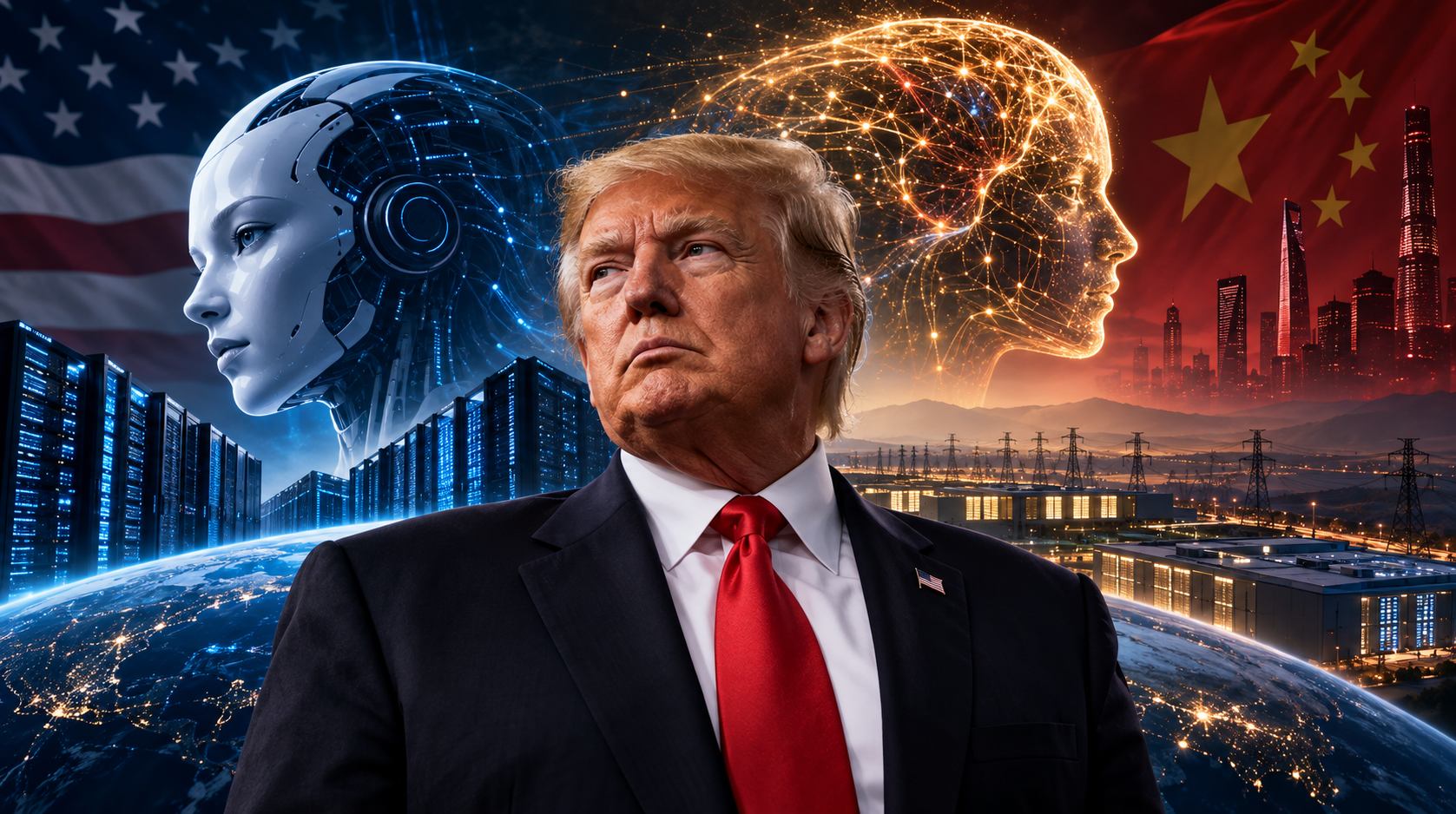
Even if American AI companies agreed to slow down together, another problem immediately appears: China.
Artificial intelligence is increasingly viewed as a strategic technology. Governments expect it to influence economic productivity, cybersecurity, intelligence, military capabilities and scientific research. The United States therefore has a strong incentive to remain ahead of China, while China has exactly the same incentive to close the gap.
That creates a difficult contradiction. The same American companies arguing that frontier AI may need to advance more carefully also operate in a country that does not want to lose the global AI race.
A successful slowdown would therefore eventually require more than cooperation between companies. It could require international agreements, common safety standards and some method of verifying that other countries are following them. That may prove considerably harder than getting a few CEOs to agree publicly.
This is why the AI race increasingly resembles a coordination problem rather than simply a technology problem. Everyone may understand that unlimited acceleration carries risks, but nobody wants to slow down first while everyone else keeps running.
There is a lot of money behind the accelerator
The debate also matters because extraordinary amounts of money are now tied to the assumption that AI will continue advancing rapidly.
Technology companies are spending heavily on chips, data centers, electricity, cloud infrastructure and new models. Investors have placed enormous valuations on companies positioned throughout the AI ecosystem. Many of those investments are based on expectations that each new generation of AI will become significantly more capable than the one before it.
If frontier development eventually becomes slower or subject to much stronger safety requirements, that would not mean the AI boom is over. It could instead change where the money goes. More investment could shift from constantly training larger models toward actually deploying the intelligence we already have across finance, healthcare, manufacturing, logistics, software and everyday business operations.
That distinction matters. The long-term economic value of AI does not necessarily depend on producing a dramatically more powerful model every few months. There may already be enormous value waiting to be created simply by integrating today's systems effectively into the real economy.
Why this moment matters
There have been warnings about artificial intelligence for years. What makes this moment different is where the warnings are coming from.
Dario Amodei is not an outside activist asking technology companies to stop. Sam Altman is not an academic watching the industry from a distance. Elon Musk is not disconnected from the AI race. These are people directly involved in building and financing some of the world's most advanced AI systems.
Their agreement does not prove that disaster is approaching, and it certainly does not mean the AI race is about to stop. These companies will continue competing, investing and releasing new technology.
But something important has changed.
The debate is no longer simply about who can build the most powerful AI first. It is increasingly about whether the industry can continue pushing the frontier forward while keeping enough control over the speed of that progress.
And when the people with their feet on the accelerator start discussing the brakes, it is worth asking what they are seeing ahead.
Sources
Educational content. This article is general information, not personalised investment, accounting, legal, tax or financial advice, and no outcome is guaranteed. Check anything important against your own circumstances and a qualified professional. Full disclaimer.

Mike Sader
Master's in Finance and class valedictorian at USJ Beirut, then around four years of Big Four external audit across banking, energy and management services. I write about money, careers and business for people who want the reasoning, not the buzzwords.
More about meGet the newsletter
A short email when something is worth understanding. No noise, no hype, unsubscribe in one click.