Trump Wants to Replace “AI” With “SI.” But Superintelligence Means Something Much Bigger.
Donald Trump wants the U.S. government to start calling artificial intelligence “Superintelligence,” or SI. But superintelligence already means something much bigger—and the announcement reveals how AI is becoming an economic, infrastructure and geopolitical race.
On this page8
- AI and Superintelligence Are Not the Same Thing
- Why Trump Wants to Change the Name
- The Real Competition Is Bigger Than AI Models
- Why the United States and China Matter So Much
- The Race Toward Actual Superintelligence
- What Happens If Superintelligence Actually Arrives?
- From Software to Strategic Infrastructure
- The Bigger Picture
Artificial Intelligence has become one of the defining technologies of this decade. In only a few years, AI has moved from something most people associated with research laboratories and science fiction to a technology being integrated into businesses, financial markets, healthcare, education, defense and everyday life. Now, Donald Trump wants the United States to start using a different term for it: Superintelligence, or SI.
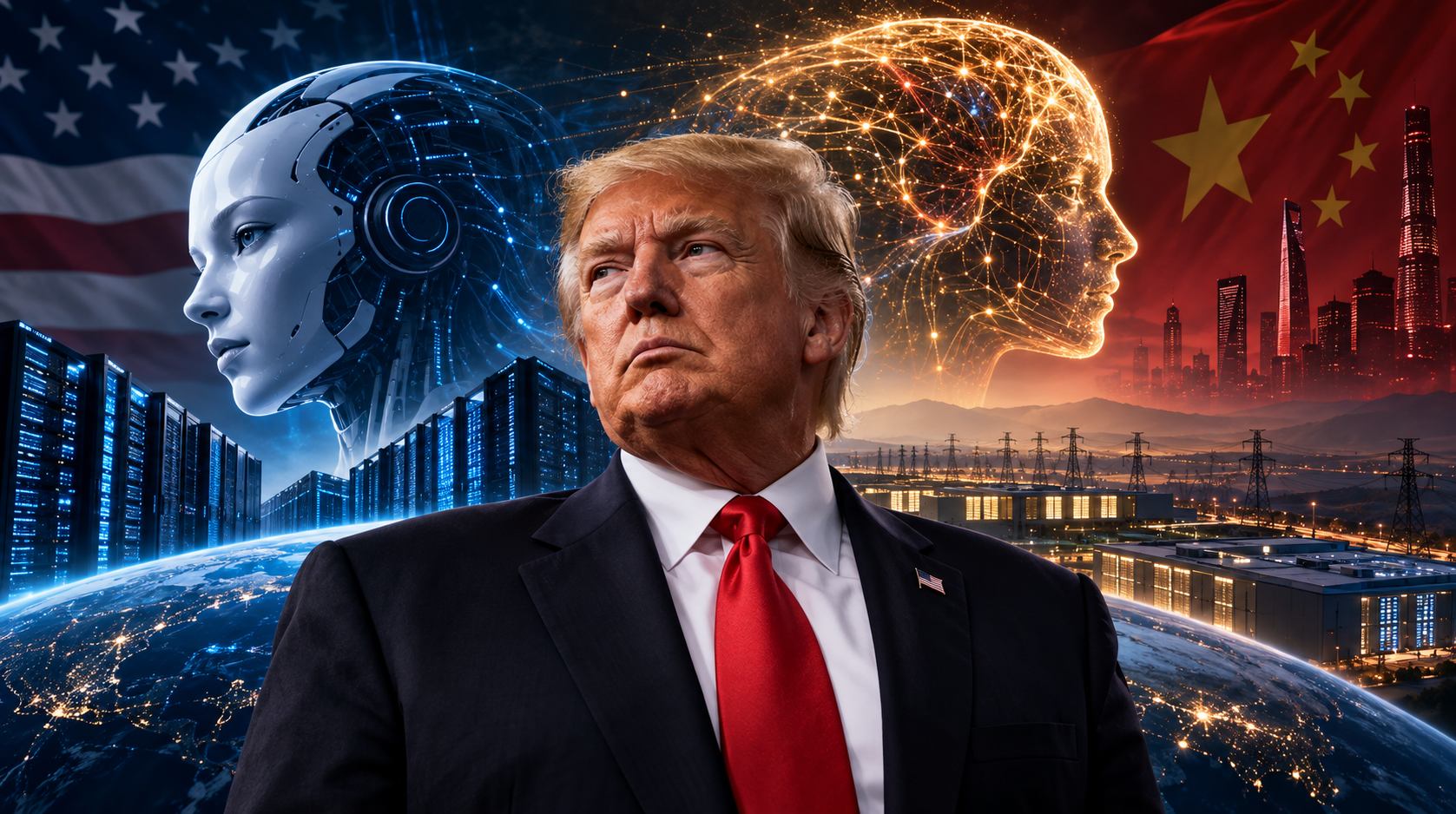
Speaking at the United Nations General Assembly on September 22, 2026, Trump said that U.S. government documents would begin referring to artificial intelligence as “Superintelligence,” arguing that the word artificial makes the technology sound fake or somehow less significant than it really is. His announcement might initially sound like a simple branding exercise, but it comes at a much more important moment. The United States, China and the world's largest technology companies are investing enormous amounts of money into increasingly capable AI systems, while governments are beginning to treat the technology not simply as software, but as infrastructure with economic, military and geopolitical importance.
There is also an important problem with Trump's proposed terminology: superintelligence already means something very different in the world of AI. Calling today's systems “SI” risks mixing together technologies that already exist with a theoretical level of intelligence that humanity has not yet demonstrated.
AI and Superintelligence Are Not the Same Thing
Artificial intelligence is an extremely broad category. It includes systems capable of performing tasks that traditionally required some form of human intelligence, such as understanding language, recognizing images, writing software, analyzing large amounts of information, generating content or making predictions. Chatbots, autonomous-driving systems, recommendation algorithms and many financial models can all fall somewhere within this broad AI ecosystem, even though their capabilities differ enormously.
Superintelligence traditionally describes something much more ambitious. The concept generally refers to an artificial intelligence that significantly exceeds human intellectual capabilities across a broad range of important domains. Such a system would not simply answer questions faster than humans or generate better images. In theory, it could outperform leading human experts in areas such as scientific research, engineering, strategic reasoning, software development and potentially the development of even more advanced AI systems.
This distinction is why the terminology matters. Today's most advanced AI models can already outperform humans on certain individual tasks while remaining unreliable or limited on others. Calling all of this “superintelligence” effectively removes the distinction between the AI systems we have today and a potential future technology that could represent an entirely different level of capability.
| Term | General Meaning |
|---|---|
| AI | The broad field of machines performing tasks associated with intelligence |
| AGI | A debated concept generally referring to highly capable general-purpose intelligence across many domains |
| Superintelligence / ASI | A hypothetical intelligence substantially exceeding human capabilities across a broad range of cognitive tasks |
The exact boundaries between these concepts remain debated, particularly around AGI. However, the important point is that AI already exists, while genuine artificial superintelligence remains a prospective capability rather than simply another name for today's technology.
Why Trump Wants to Change the Name
Trump's argument is partly linguistic, but the broader message is strategic. During his UN speech, he presented the technology as potentially more consequential than previous technological revolutions and connected leadership in advanced AI directly to international competition. His administration has increasingly argued that the United States must move quickly enough to maintain technological leadership rather than allowing regulation to significantly slow development.
That position fits a much broader change in Washington's approach to AI. The technology is increasingly being discussed alongside national security, military capabilities, cybersecurity, semiconductor manufacturing, energy infrastructure and competition with China. The Trump administration has also pushed for faster adoption of advanced AI within the national-security establishment while maintaining requirements surrounding control and human accountability.
This means the debate is moving far beyond whether a chatbot can write an email or whether companies can automate administrative work. Governments are increasingly asking what happens if advanced AI becomes essential to intelligence gathering, scientific discovery, military planning, cyber operations, manufacturing or economic productivity. If those capabilities become strategically important, the country controlling the strongest AI ecosystem could potentially gain advantages that extend far beyond the technology industry.
Trump's choice of the word “Superintelligence” therefore communicates something about how his administration wants people to think about AI. The technology is being framed not simply as another generation of software, but as a potential source of national power.
The Real Competition Is Bigger Than AI Models
When people think about the AI race, they often focus on companies building models. The developers behind today's most capable systems receive most of the attention because their products are what consumers actually experience. But increasingly capable AI requires a much larger physical and financial ecosystem underneath it, and this is where the economic implications become especially significant.
Training and operating frontier AI models requires enormous computing capacity. That creates demand for advanced semiconductors, data centers, networking equipment, cooling systems and increasingly large quantities of electricity. Building that infrastructure requires land, construction, financing and access to energy. The AI race is therefore beginning to affect industries that initially appeared far removed from artificial intelligence itself.
A simplified version of this ecosystem increasingly looks like:
Semiconductors → Data Centers → Electricity → Cloud Infrastructure → AI Models → Applications → Automation
Each layer creates investment requirements and potential bottlenecks. A company may develop an extraordinary model, but without enough advanced chips it cannot scale it. A country may have access to chips, but without sufficient electricity and data-center capacity it may struggle to operate them at the necessary scale. This is why the geopolitical competition surrounding AI increasingly includes semiconductor manufacturing, energy policy, export restrictions and infrastructure investment.
The companies eventually capturing the most economic value from AI may therefore not be limited to those producing the models. Semiconductor manufacturers, electricity producers, data-center operators, cloud providers, cybersecurity companies and businesses capable of successfully integrating AI into existing industries could all become important parts of the economic transformation.
Why the United States and China Matter So Much
The geopolitical dimension becomes clearer when looking at the competition between the United States and China. Both countries understand that advanced AI could influence productivity, scientific research, industrial capacity and national security. As a result, access to the infrastructure required to develop powerful AI systems has increasingly become a strategic issue rather than purely a commercial one.
The United States benefits from a powerful ecosystem of AI developers, cloud-computing companies, semiconductor designers, universities and capital markets. China, meanwhile, has enormous industrial capacity, a large domestic technology market and strong incentives to reduce its dependence on American technology. Restrictions surrounding advanced semiconductors have consequently made computing power itself part of the geopolitical competition.
This creates a difficult policy problem. Governments want AI systems to be safe, controllable and reliable, particularly as their capabilities increase. At the same time, policymakers worry that restrictions that are too aggressive could slow domestic companies while competitors continue advancing. The question therefore becomes not simply how AI should be regulated, but how much technological risk governments are willing to accept in order to maintain strategic leadership.
That tension is central to the current American debate. The emphasis on acceleration, infrastructure and technological leadership exists alongside increasingly serious questions about safety, cybersecurity and control. How governments balance those objectives will become increasingly important as AI systems become more capable.
The Race Toward Actual Superintelligence
This is where Trump's terminology becomes especially interesting. Even if calling today's AI “SI” is technically questionable, some of the companies developing frontier models are genuinely pursuing systems that could eventually become dramatically more capable than today's technology.
The progression from today's AI toward AGI and potentially superintelligence is not guaranteed, nor is there scientific consensus about when or whether those thresholds will be reached. Predictions vary enormously. What is clear, however, is that companies are investing extraordinary amounts of capital because they believe increasingly powerful models could generate enormous economic value.
If AI continues improving rapidly, the implications could extend far beyond productivity software. More capable systems could accelerate drug discovery, engineering, materials science, coding and scientific research. AI agents could potentially perform increasingly complex business processes with limited human intervention, while robotics could eventually connect advanced intelligence to physical work.
At that point, the economic question changes dramatically. We would no longer simply be discussing software that helps workers become more productive. We would be discussing systems capable of performing a growing share of cognitive economic activity themselves.
That possibility explains both the extraordinary investment and the growing concern surrounding advanced AI.
What Happens If Superintelligence Actually Arrives?
True superintelligence would represent something fundamentally different from the technologies businesses are deploying today. If a system could outperform humans across scientific research, engineering, programming, strategic reasoning and other economically valuable activities, the consequences would be extremely difficult to predict.
The optimistic scenario is enormous. Scientific discoveries that currently take decades could potentially happen much faster. New medicines could be developed more efficiently, energy technologies could improve, businesses could become dramatically more productive and entire industries could be transformed by lower costs and faster innovation. Economic growth could potentially accelerate significantly if intelligence itself became abundant and inexpensive.
But the same capabilities create serious questions about control, employment, cybersecurity and concentration of power. If only a small number of governments or corporations controlled genuinely superintelligent systems, the economic and political influence associated with that technology could be extraordinary. The consequences of mistakes would also become larger as systems gained greater autonomy and access to important infrastructure.
This is why the debate around advanced AI increasingly contains two seemingly contradictory ideas. One side sees an enormous opportunity that countries cannot afford to miss. The other sees a technology whose capabilities may eventually require safeguards far stronger than those surrounding ordinary software. Both concerns can exist simultaneously.
From Software to Strategic Infrastructure
The most important part of Trump's announcement may therefore have little to do with whether people actually start saying “SI.”
The term Artificial Intelligence is already deeply embedded in research, business, regulation and everyday language, while superintelligence already carries a specific meaning within discussions about advanced AI. Replacing one with the other may therefore create more confusion than clarity.
But underneath the terminology, something important is changing. AI is moving from being treated primarily as a technology product toward being treated as strategic infrastructure. Governments are thinking about the chips required to build it, the electricity required to operate it, the data centers required to scale it and the national-security implications of allowing another country to develop superior systems first.
That transformation could have enormous consequences for investment. The AI boom is already driving capital toward semiconductors, data centers and energy infrastructure, but the next phase could extend into robotics, industrial automation, healthcare, defense, cybersecurity and scientific research.
For businesses, the question will increasingly become less about whether they should “use AI” and more about how AI changes their competitive position. Companies that successfully integrate the technology may become substantially more productive, while companies that ignore it could eventually find themselves competing against organizations with fundamentally lower operating costs.
The Bigger Picture
Trump's attempt to replace “Artificial Intelligence” with “Superintelligence” can easily be dismissed as branding. Technically, the two terms are not interchangeable, and today's AI systems should not automatically be described as superintelligent simply because they have become more powerful.
But focusing only on the terminology misses the more important development. The world's largest economies increasingly believe that leadership in advanced AI could influence economic growth, military capability, scientific progress and geopolitical power. That belief is driving enormous investments in chips, electricity, data centers and AI infrastructure while simultaneously creating difficult questions about regulation and safety.
The real transition, therefore, may not be from AI to SI. It may be from AI as software to AI as infrastructure, and eventually from infrastructure to strategic power.
Whether genuine superintelligence arrives in a few years, several decades or never at all remains uncertain. But governments and companies are already investing as though the possibility matters.
And that may ultimately be the most important part of Trump's announcement: the race for the next generation of intelligence is no longer being treated simply as a technology race. It is becoming an economic and geopolitical one.
Sources
- 1.https://www.reuters.com/legal/government/trump-says-us-will-henceforth-call-ai-super-intelligence-2026-09-22/
- 2.https://rollcall.com/factbase/trump/transcript/donald-trump-speech-81st-united-nations-general-assembly-september-22-2026/
- 3.https://www.whitehouse.gov/fact-sheets/2026/06/fact-sheet-president-donald-j-trump-signs-historic-directive-on-ai-in-the-national-security-enterprise/
- 4.https://www.whitehouse.gov/ai/
Educational content. This article is general information, not personalised investment, accounting, legal, tax or financial advice, and no outcome is guaranteed. Check anything important against your own circumstances and a qualified professional. Full disclaimer.

Mike Sader
Master's in Finance and class valedictorian at USJ Beirut, then around four years of Big Four external audit across banking, energy and management services. I write about money, careers and business for people who want the reasoning, not the buzzwords.
More about meGet the newsletter
A short email when something is worth understanding. No noise, no hype, unsubscribe in one click.